

The Living Dead: Three Grateful Dead tributes
Charles Hughes on three Dead tribute albums, including a great new one

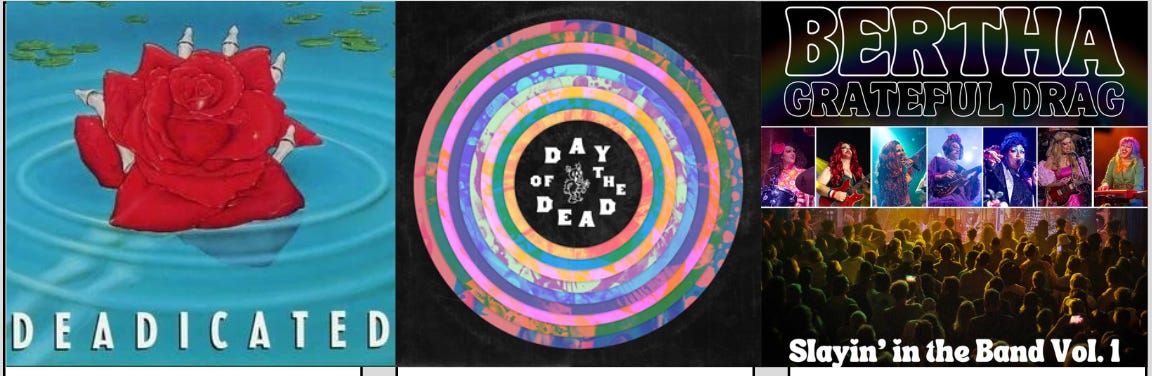
Last week, Nashville-based Grateful Dead tribute band Bertha released their debut recording, Slayin’ in the Band, Vol. 1. The band (composed of accomplished East Nashville musicians) performs in drag, which began as a protest against Tennessee’s anti-LGBTQ+ legislation and has become their calling card as they’ve built a national reputation as a touring act. This delightful new release comes at an auspicious time in the Dead’s continuing history: the deaths of Donna Jean Godchaux-MacKay, Phil Lesh, and Bob Weir in the last two years have both symbolized the closing of the original Dead era and suggested that its music may continue through the many fans and admirers who have taken up the band’s spirit and repertoire.
Slayin’ in the Band, Vol. 1 also coincides with big anniversaries for two notable Dead tributes, 1991’s Deadicated (which turns 35 this year) and 2016’s Day of the Dead (celebrating its 10th birthday). Each album serves a distinct purpose. Deadicated celebrates the band’s importance as song-crafters and record-makers. Day of the Dead luxuriates in their exploratory spirit. And Slayin’ in the Band: Vol. 1 joyously invokes their live shows and the communities built through them. Additionally, each raised money and awareness for an important social cause. Deadicated was a benefit for the preservation of the rainforest, a keystone in that era of celebrity activism. Day of the Dead came out under the banner of the Red Hot Organization, whose releases for AIDS awareness and affiliated causes have spanned five decades. And Bertha contributes a portion of proceeds from Slayin’ In The Band to Trans Aid Nashville in support of the community whose battles against state-sanctioned bigotry inspired their work. (The group repeatedly invokes a key lyric from “Scarlet Begonias” – “I knew right away she was not like other girls” – with a celebratory defiance that earns cheers from the audience.) The combined albums work individually or in combination, and Bertha’s recorded debut proves that they deserve a place among their more famous (for now, at least) Deadhead colleagues. Let’s take a look back, and forward, at these three celebrations of one of the great rock ‘n’ roll bands.
Deadicated doesn’t take many chances, instead preferring to settle down in the expensive-sounding reverence that defined so many ‘90s tribute albums. Your mileage may vary on this format, but it ends up working in this record’s favor. Drawing from a relatively limited set of songs in terms of style and chronology, Deadicated pulls together a range of rock, country, and folk performers whose contributions all claim space for the band as both influences and counterparts at the dawn of the ‘90s. The best tracks are the ones that hew closest to the originals: Los Lobos’ raucous opening “Bertha,” Indigo Girls’ invocatory “Uncle John’s Band,” or Lyle Lovett’s simmering “Friend of the Devil” particularly come to mind. It’s not a surprise (and perhaps a bit of a cheat) that the best track of all is Dead associate Bruce Hornsby’s take on “Jack Straw,” which pairs the song’s epic tale with the bold, vibrant productions typical of Hornsby and his band in their hit-making period.
The artists only take big chances near the end, with a stretch that includes Midnight Oil’s clattering deconstruction of “Wharf Rat,” Burning Spear’s dubbed-out “Estimated Prophet,” and the closing shimmer of Jane’s Addiction’s take on “Ripple.” This isn’t necessarily the most successful part of the album, but it’s the only time when Deadicated gestures towards the freakier, funkier sides of the Dead’s catalog and ethos. And Jane’s Addiction, in particular, understands the assignment.
2016’s Day of the Dead spends far more time traveling through that dimension. A massive collection organized by Aaron and Bryce Dessner of The National (who appear throughout as both back-up musicians and featured artists) reimagines the tribute-album format for the deep-dive era of torrents and streaming. Day of the Dead makes the most of its six-hours-long expansiveness, covering the breadth of the band’s catalog and incorporating quite a few traditional songs that they made their own over the years. (Not to mention a reimagining of a selection from John Oswald’s Grayfolded project, and an original piece from Bryce Dessner based around Jerry Garcia’s guitar solo from a live version of “Althea” from 1990.) The artist roster is more expansive, too, gathering inheritors, contemporaries, and elders from several countries and many overlapping musical traditions. Many of the versions here stick to the original arrangements – including the returning Hornsby, who's hymnlike take on “Black Muddy River” backed by Justin Vernon’s project DeYarmond Edison bridges his earlier era with his rebirth as a surprising hero of this new indie cohort. (And which, like his Deadicated offering, might by the highlight of the whole thing.)
But there are many reinventions here, the best of which (Anohni’s mournful “Black Peter,” Orchestra Baobab’s jubilant Afro-beat reworking of “Franklin’s Tower,” Lucinda Williams’ deep-soul reimagining of “Going Down the Road Feelin’ Bad,”) diverge from the familiar in engaging and enriching ways. In its length and vibe shifts, Day of the Dead approximates a stretched-out Dead show, complete with a “Drums/Space” and an encore-like closer of Bob Weir himself appearing with The National for a run through “I Know You Rider.” (Weir also appears earlier with Wilco on “St. Stephen.”) Alternately loose-fitting and tightly composed, the songs here feel like responses, or re-imaginings, rather than tributes. In all its overstuffed excess, Day of the Dead embraces the spirit of experimentation that’s absent on the restrained, elegant Deadicated: fittingly, it’s both more uneven and more interesting.
Slayin’ In The Band, Vol. 1 is more fun than either of them. The joy and spark of Bertha’s performances (collected here from a few recent shows) eschew any hint of ponderousness, while their crackling performances remind that – on top of being a great idea – this band is made up of a crew of expert musicians whose ability to re-create faithfully doesn’t hinder their interest in heading in new directions. (The group is fronted by Melody Walker and Caitlyn Doyle and features a rotating cast of top players and singers.) Their namesake track “Bertha” is a boisterous high point, as is the languid “Friend of the Devil” that takes its arrangement from the slowed-down live version that the Dead played in the 1980s, or the gorgeous “Stella Blue” that drifts along atop tender guitar. Constructed like a Dead show, complete with a spacier second set that features a great trip through the well-known “Scarlet Begonias”/“Fire on the Mountain” sequence, Slayin’ In The Band, Vol. 1 ends with the biggest flex of all: the full “Terrapin Station” suite, a worthy climax for such a loving, living performance.
The last sound on Slayin’ in the Band, after the final fade-out of “Terrapin Station,” is a distorted voice lamenting “Everything’s fuckin’ broken, I don’t know what to do.” In this moment, there may be no more relatable sentiment. But, by drawing on the evolving resonance of the Grateful Dead’s long strange trip, Bertha’s new community built from old songs suggests one way forward. Let’s hope the music never stops.
Protect trans folks.
If you like what you’re reading here, please think of subscribing to No Fences Review! It’s free for now, although we will be adding a paid tier with exclusive content soon. Also, if you’d like to support our work now, you can hit the blue “Pledge” button on the top-right of your screen to pledge your support now, at either monthly, yearly, or founding-member rates. You’ll be billed when we add the paid option. Thanks!